
Table of Contents
ToggleQuick Pain Relief from Everyday Injuries
It only takes a split second for a fun afternoon, a workout, or even a routine chore to end with a painful sprain or strain. One awkward step, simple twist, or heavy lift, and the next moment you will find yourself wincing in pain.
At Family Urgent Care, we provide fast and reliable urgent care for sprains in Chicago & Northwest Indiana when waiting isn’t an option.
Our expert medical team will evaluate your symptoms and determine the underlying cause of your muscle pain.
You can also rely on us for sprain urgent care for kids, so they don’t have to miss out on their favorite fun activities for longer.
Walk-in for same day care at any of our locations in Northwest Indiana and Chicago and get treated without hassle.
Sprain vs Strain: What’s the Difference
| Sprain | Strain |
|---|---|
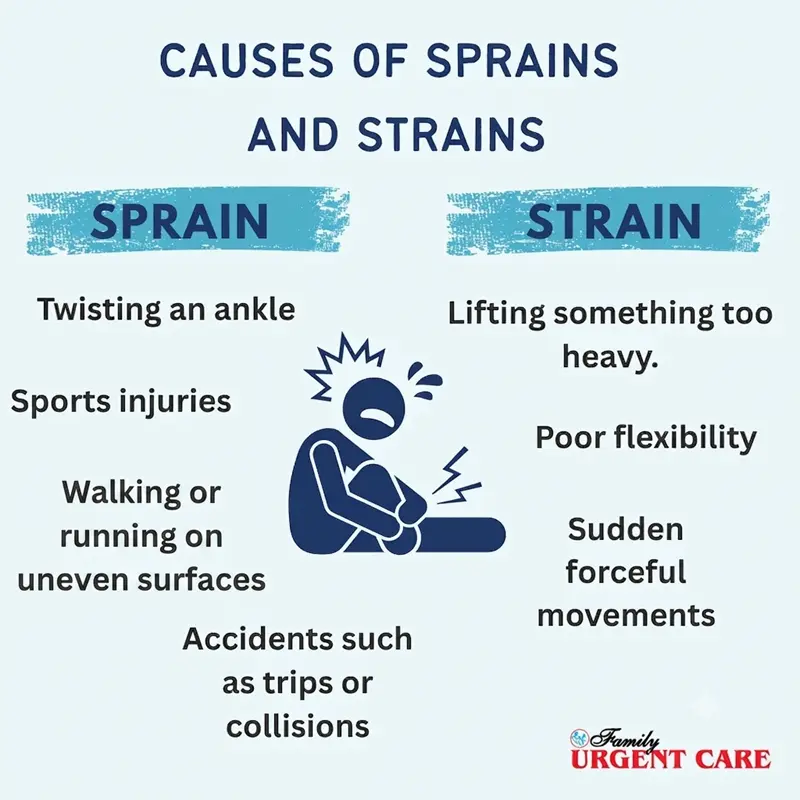
| A sprain happens when ligaments (the tough bands of tissue that connect bone to bone at a joint) are stretched or torn. | A strain occurs when muscles or tendons (the cords that connect muscles to bones) are overstretched or torn. |
| Common sites: ankle, knee, wrist. | Common sites: hamstring, lower back, and shoulder. |
| Example: Twisting your ankle and tearing the ligament. | Example: Lifting something heavy and pulling your back muscle. |
Many sprains and strains can heal on their own, but in some cases, seeking treatment from urgent care centers is recommended. At Family Urgent Care, you will receive treatments such as pain management and follow-up care.
Symptoms
Sprains and strains often share similar symptoms, but a few key differences can help identify the type of injury.
- Worsening Pain
- Swelling
- Bruising, more common with sprains
- Limited range of motion or difficulty moving the injured area
- Muscle spasms, commonly associated with strains
- Tenderness
- Weakness or instability
When Should You Contact a Doctor for Sprain and Strain Injuries?
Seek medical care immediately if you notice any of the following conditions:
- Unable to walk properly
- Difficulty bearing weight
- Persistent swelling or bruising
- Severe pain that doesn’t improve with rest
- Numbness, tingling, or weakness in the injured limb
- Chances of a minor fracture
Why Choose Family Urgent Care for Sprain Injuries
Here is why people rave about our services.
Accurate Diagnosis
A sprain, strain, or fracture can feel surprisingly similar. At Family Urgent Care, we perform a thorough evaluation and use on-site X-rays to get to the root cause of your pain. This helps us map out the right treatment plan for you without any guesswork.
Cost-Effective
Quality treatment shouldn’t come with an overwhelming bill. We offer comprehensive sprain urgent care at a much lower cost than ER, keeping healthcare affordable for all.
Walk-In Visits
When every step hurts, waiting isn’t an option. With no appointment required, you can walk into our clinic and get the same day urgent care for sprains in Chicago & Northwest Indiana without long waits.
Aftercare Support
Healing doesn’t end when you leave the exam room. We stay with you at every stage of recovery with proper follow up care, bracing support, and therapy guidance so you get back to comfortable movement in no time.
How Can Family Urgent Care Help in Treating Sprains and Strains?
A sprain or strain shouldn’t keep you sidelined for longer. At Family Urgent Care, we’re equipped with advanced X-ray machines, which enable us to image the injured area and provide accurate diagnosis.
Our sprain treatment urgent care services include everything from pain management, bracing support, RICE method, therapy recommendations to follow up care all under one roof.
We also offer urgent care for child sprains and minor fractures without long waits, so your little one doesn’t have to be in pain for longer.
Looking for medical advice and online check ups from the comfort of your home? Our telemedicine support has come to the rescue. You can also connect with our doctor via phone or video appointment, wherever you are.
Visit our walk-in clinics in Chicago & Northwest Indiana for same-day care and get the ultimate relief your body has been craving for.
Frequently Asked Questions
Yes, urgent care for muscle strain involves evaluating the injury, finding the exact cause, and providing appropriate treatment without long waits. Your provider may also refer you for imaging if a more serious injury is suspected.
Urgent care will examine your ankle to identify the extent of the sprain and rule out a fracture. Your provider may recommend the RICE method (rest, ice, compression, and elevation), provide a brace or wrap for support, prescribe pain relief if needed, and order an X-ray if a broken bone is possible. Common medicines urgent care give for sprained ankle include over the counter pain relievers such as ibuprofen (Advil) and naproxen (Aleve).
Yes, you can go to urgent care for a sprained toe if you experience severe pain, persistent swelling, numbness, difficulty moving, or signs of a possible fracture. At Family Urgent Care, we assess your injury, look out for fractures, and recommend proper treatment to prevent complications and support faster healing
You can avoid sprains and strains in the workplace by following proper lifting techniques (try to lift with leg not back), regular exercise and stretching, taking regular breaks during repetitive tasks, wearing proper footwear, and maintaining a good posture. Keeping your work area clutter free can also reduce the risk of injury.
Well, it depends on how severe your injury is. Mild sprains usually get better within 2 to 4 weeks, while moderate injuries may heal in 4 to 8 weeks. If you have a severe injury that includes torn ligaments or muscles, it may take several months with proper treatment and rehabilitation support in some cases.
A sprain is an injury to a ligament, the tissue that connects bones at a joint. A strain is an injury to a muscle or tendon, the tissue that connects muscle to bone. While both can lead to pain, swelling, and limited movement, they involve different soft tissues.
The first aid usually comes down to the RICE method for strains and sprains that includes:
- Rest: Resting the injured area without putting extra weight onto it.
- Ice: Apply ice for 15 to 20 mins at a time to reduce swelling.
- Compression: Wrap an elastic bandage around the injured part.
- Elevation: Keep your injury raised above the heart level.
Visit Family Urgent Care, if you have severe swelling, pain and difficulty bearing weight.